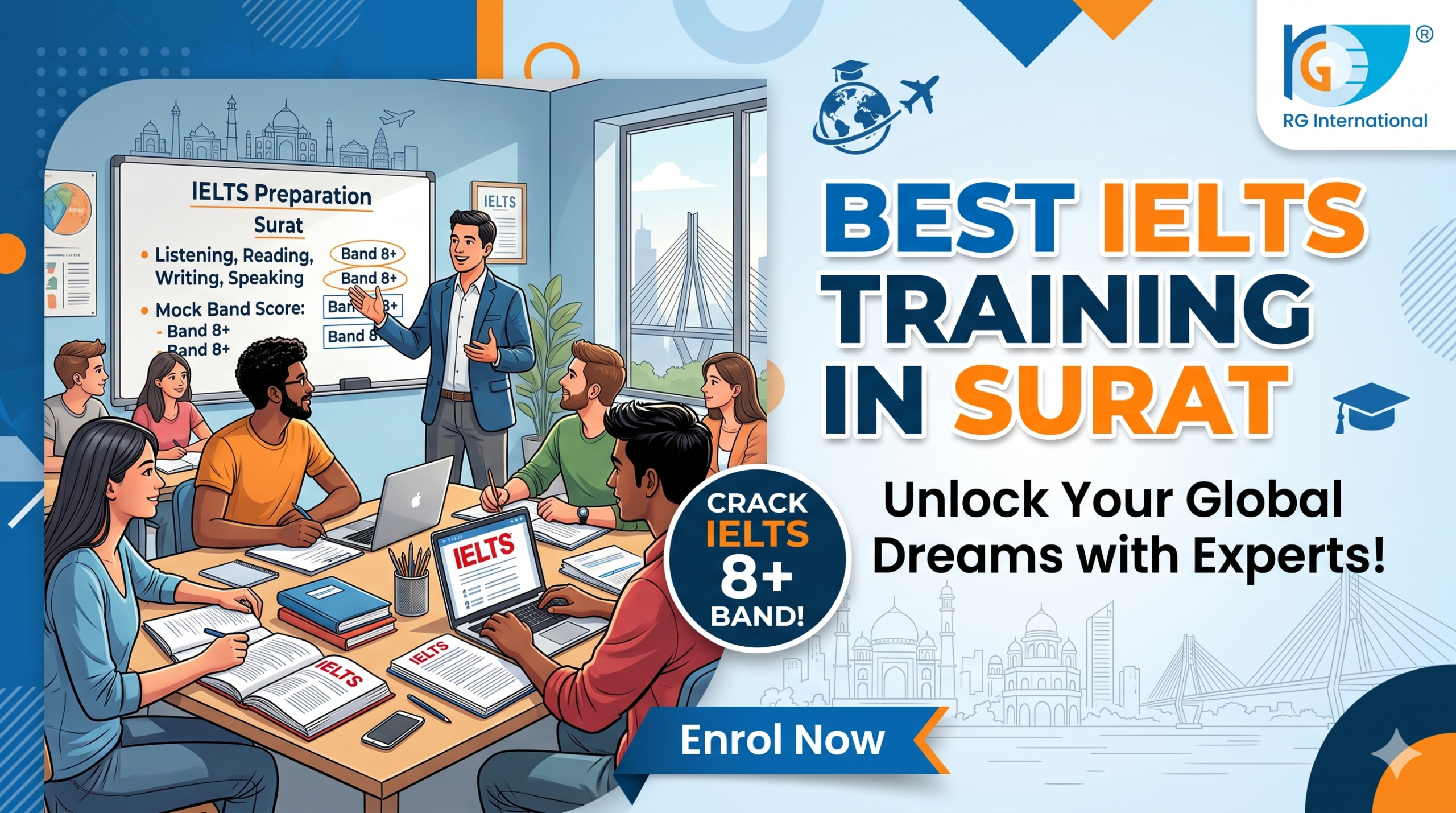
Every year, thousands of students and professionals in Surat and across Gujarat face the same question before beginning their study abroad journey: should I take the PTE Academic or the IELTS exam? Both tests assess English language proficiency. Both are accepted by universities, immigration authorities, and professional bodies worldwide. But they are fundamentally different in format, scoring, difficulty level, and strategy — and the right choice depends entirely on your strengths, timeline, and target destination.
At RG International, we help students make this decision every day. Our experienced language coaching team has trained hundreds of candidates for both exams, and we understand what works for different learner profiles. This guide breaks down everything you need to know about PTE Academic vs IELTS — so you can stop second-guessing and start preparing.
Table of Contents
ToggleWhat Is the IELTS Exam?
The International English Language Testing System (IELTS) is one of the most widely accepted English proficiency tests in the world. It is jointly managed by the British Council, IDP Education, and Cambridge Assessment English. IELTS tests four skills — Listening, Reading, Writing, and Speaking — and is available in two formats: Academic (for university admissions) and General Training (for immigration and work visas).
IELTS is scored on a band scale from 1 to 9, with most universities requiring a minimum of 6.0 to 7.5 depending on the program and institution. The Speaking test is conducted face-to-face with a certified human examiner, which many candidates find either reassuring or nerve-wracking depending on their personality.
To understand the full structure and scope of the IELTS exam, visit the RG International IELTS guide.
What Is the PTE Academic Exam?
The Pearson Test of English Academic, commonly known as PTE Academic, is a computer-based English language proficiency test developed and administered by Pearson PLC. Unlike IELTS, the entire PTE exam — including the Speaking component — is evaluated by an AI-powered automated scoring system with no human examiner involvement.
PTE Academic tests the same four skills as IELTS — Speaking and Writing (combined section), Reading, and Listening — but the format, question types, and time structure are significantly different. Scores range from 10 to 90, with most universities accepting 58 to 79 or above depending on their requirements.
The PTE exam takes approximately three hours to complete in a single uninterrupted session, compared to IELTS which spreads across multiple sittings including a separately scheduled Speaking test.
Key Differences Between PTE Academic and IELTS
Understanding the structural differences between the two exams is the foundation of making the right choice.
Exam Format
IELTS uses a combination of computer-based and paper-based formats depending on the test center. The Speaking module is always conducted face-to-face with a human examiner on a separate day. PTE Academic is entirely computer-based, and the Speaking section is recorded and scored by AI — there is no human interaction at any point.
Total Duration
IELTS takes approximately 2 hours and 45 minutes for the Listening, Reading, and Writing components, with the Speaking test scheduled separately — often on a different day. PTE Academic is completed in approximately 2 hours and 15 minutes in a single continuous session.
Score Reporting Speed
This is one of the biggest practical differences. PTE Academic typically delivers results within 48 hours of the exam. IELTS results take 3 to 13 days depending on whether you took the computer-delivered or paper-based version. For students working with tight application deadlines, PTE’s speed can be a decisive advantage.
Score Validity
Both IELTS and PTE scores are valid for two years from the date of the test.
Accepted Destinations
IELTS is recognized by over 11,000 institutions globally including almost all universities in the UK, Canada, Australia, New Zealand, Ireland, and a growing number in the USA. PTE Academic is accepted by thousands of institutions worldwide and is particularly favored for Australian student visas and New Zealand immigration. For Canadian and UK admissions, IELTS remains more universally accepted, though PTE acceptance has expanded significantly.
For students planning to study in the UK, IELTS remains the standard. For those targeting study in the USA, both PTE and IELTS are widely accepted alongside TOEFL. For Canada immigration via Express Entry, IELTS is the primary accepted test, though PTE Core has been introduced as an alternative.
PTE Academic vs IELTS: Which Is Easier to Score in?
This is the core question — and the honest answer is that it depends on the individual candidate. There is no universally easier exam. However, there are clear patterns based on learner strengths.
PTE Academic tends to suit candidates who:
- Are comfortable with computers and typing quickly and accurately
- Prefer structured, time-limited question formats with no room for subjectivity
- Get anxious speaking to a human examiner and prefer speaking into a microphone
- Need results quickly due to upcoming application deadlines
- Have strong note-taking and multi-tasking abilities, since several PTE tasks integrate multiple skills simultaneously
- Prefer a shorter, single-session exam experience rather than multiple sittings
IELTS tends to suit candidates who:
- Communicate naturally and confidently in spoken English and want a real conversation
- Prefer writing by hand (Paper-Based IELTS) over typing
- Find face-to-face interaction easier than speaking to a microphone
- Are targeting institutions or immigration pathways where IELTS is specifically required
- Have more preparation time available and prefer a lower-paced exam format
- Are targeting countries like Canada, the UK, or Finland where IELTS is the dominant accepted test
At RG International, our language coaching experts conduct a free proficiency and preference assessment before recommending which exam suits a specific student. This diagnostic approach ensures that students are not just prepared well — they are prepared for the right exam.
PTE Academic: Section-by-Section Breakdown
Speaking and Writing (Combined Section — approximately 77 to 93 minutes)
This combined section includes tasks such as Read Aloud, Repeat Sentence, Describe Image, Retell Lecture, Answer Short Question, Summarize Written Text, and Write Essay. The diversity of task types in this section means candidates need to be versatile — switching between speaking, listening, reading, and writing within the same section.
Reading (approximately 32 to 41 minutes)
PTE Reading includes tasks such as Fill in the Blanks (drag and drop), Multiple Choice (single and multiple answers), Re-order Paragraphs, and Reading and Writing Fill in the Blanks. Unlike IELTS, PTE Reading questions often assess grammar and vocabulary rather than pure comprehension, making vocabulary range a critical skill.
Listening (approximately 45 to 57 minutes)
PTE Listening tasks include Summarize Spoken Text, Multiple Choice, Fill in the Blanks, Highlight Correct Summary, Select Missing Word, Highlight Incorrect Words, and Write from Dictation. The Write from Dictation task in particular is one of the highest-scoring items in PTE and can significantly lift or drag down your overall Listening score.
Our PTE coaching in Surat at RG International covers every task type in detail, with practice templates, timed drills, and AI-scored mock tests to prepare students for every section.
IELTS: Section-by-Section Breakdown
Listening (approximately 30 minutes)
The IELTS Listening module consists of four sections. Sections 1 and 2 are based on everyday social contexts, while Sections 3 and 4 involve academic or professional settings. The recording plays once only, which means concentration and note-taking ability are critical.
Reading (60 minutes)
In the Academic version, IELTS Reading contains three long passages from academic sources. Question types include True/False/Not Given, Matching Headings, Sentence Completion, Multiple Choice, and Summary Completion. The General Training version uses shorter and more practical texts.
Writing (60 minutes)
Task 1 requires describing a graph, chart, diagram, or map. Task 2 is a full essay of at least 250 words. As detailed in our comprehensive guide to IELTS Writing Task 2 essay types, understanding the essay format is essential for scoring well.
Speaking (11 to 14 minutes)
The IELTS Speaking test is a face-to-face interview divided into three parts: a short introduction and general questions, a one-minute cue card topic, and a longer discussion related to the cue card topic. The human examiner interaction is what differentiates IELTS Speaking most fundamentally from PTE.
Our best IELTS classes in Surat include dedicated Speaking practice sessions with live feedback and mock interviews to ensure students are fully prepared for the face-to-face format.
Scoring: PTE vs IELTS Equivalents
Understanding how PTE and IELTS scores map to each other helps students determine their target score for each exam.
A PTE score of 50 is roughly equivalent to an IELTS band of 6.0. A PTE score of 58 maps to approximately IELTS 6.5. A PTE score of 65 is equivalent to IELTS 7.0. A PTE score of 79 corresponds to approximately IELTS 8.0.
These equivalencies are approximate and institutions may have their own conversion standards. Always verify the specific score requirement for your target university or immigration pathway before deciding which exam to take.
For a comprehensive overview of all major English language tests and their use cases, visit the RG International guide to mastering international tests including TOEFL, IELTS, PTE, and SAT.
Common Mistakes Candidates Make When Choosing Between PTE and IELTS
One of the most common errors we see at RG International is students choosing their exam based purely on what their friends took rather than what suits their own strengths. The result is candidates who are fundamentally better suited to one test spending months preparing for the other — and underperforming as a result.
Another frequent mistake is ignoring the destination requirement. If a student is applying for Canada’s Express Entry immigration pathway, IELTS is the standard — PTE Core is an option but IELTS is far more widely used and accepted. Choosing PTE in this situation could limit options or require a second exam later.
A third mistake is underestimating the PTE’s integrated task design. Many students assume that because PTE is computer-based, it must be easier. The integrated tasks — where one task type tests multiple skills simultaneously — require a different kind of cognitive flexibility that needs specific training.
Our study abroad consultants in Surat and language coaching faculty at RG International work together to ensure that students choose the right exam for the right reason — based on their profile, their target institution, and their available preparation time.
Which Test Should You Take for Your Target Country?
United Kingdom: IELTS is the dominant test. Most UK universities specify IELTS in their entry requirements. Some institutions accept PTE Academic. If your target is a UK university, verify the institution’s accepted tests before deciding.
Canada: IELTS General Training is the primary test for Express Entry immigration. IELTS Academic is used for university admissions. PTE Core has been introduced as an alternative for immigration but is less commonly accepted. For students targeting Canadian universities through our overseas education services, we recommend IELTS unless the specific institution explicitly accepts PTE.
Australia: Both IELTS and PTE Academic are widely accepted. Australia is one of the few major destinations where PTE Academic has near-equal standing to IELTS, including for student visas.
Finland: Finnish universities of applied sciences typically accept IELTS and TOEFL. PTE acceptance is growing but remains less common. For students planning to study in Finland, IELTS or TOEFL is the safer choice.
USA: Both IELTS and PTE Academic are accepted by most US universities, though TOEFL remains the most commonly used test for American institutions. Students planning to study in the USA should verify the specific requirements of their target university.
Sweden: Swedish universities most commonly accept IELTS and TOEFL. For students interested in studying in Sweden, confirm PTE acceptance with individual institutions.
How RG International Helps You Prepare for Both PTE and IELTS
At RG International, we do not push a one-size-fits-all approach to exam preparation. Our methodology begins with understanding the student — their current English proficiency level, their typing speed and computer comfort, their anxiety levels around speaking tasks, their target score, and their application deadline.
Based on this, our expert trainers recommend the right exam and build a structured preparation plan. For PTE candidates, our coaching focuses heavily on task type mastery, AI scoring patterns, and rapid result turnaround through mock tests. For IELTS candidates, our coaching covers all four modules with an emphasis on Speaking confidence, Writing structure, and Reading speed.
Our PTE coaching in Surat includes expert tips for cracking high-value tasks like Write from Dictation, Repeat Sentence, and Describe Image — the tasks that most significantly influence your final score.
Our IELTS coaching in Gujarat is structured to deliver 7+ band scores through consistent practice, expert feedback, and proven preparation strategies.
Students in Surat can enroll at our main IELTS and PTE coaching center. We also serve students from Ahmedabad, Vadodara, and Varachha.
PTE vs IELTS: Quick Decision Guide
If you need results within 48 hours, choose PTE Academic. If your target is Canada immigration via Express Entry, choose IELTS General Training. If you are uncomfortable speaking to a human examiner, PTE Academic is the better fit. If you prefer writing by hand and a conversational speaking test, choose IELTS. If your target university specifically requires IELTS, take IELTS. If you are targeting Australia or New Zealand, both are strong options and the choice should be based on your personal strengths. If you type quickly and accurately and are comfortable with computers, PTE Academic may be the faster route to your target score.
When in doubt, speak to a counselor at RG International who can assess your profile and give a concrete recommendation.
Frequently Asked Questions: PTE Academic vs IELTS
Is PTE easier than IELTS for Indian students? Many Indian students find PTE Speaking less stressful because there is no human examiner. However, PTE’s integrated tasks and AI scoring patterns require specific training. Neither exam is universally easier — it depends on the individual’s strengths.
Which exam has higher acceptance globally? IELTS currently has higher global acceptance with over 11,000 accepting institutions. PTE Academic is accepted at thousands of institutions but is less universally required than IELTS.
Can I appear for both PTE and IELTS? Yes. Many candidates take both exams and submit whichever score is higher or more appropriate for their application. There is no restriction on taking both.
How many times can I retake IELTS or PTE? Both exams can be retaken as many times as needed. There is no limit on attempts for either test.
Which exam is better for a student visa? For Australian and New Zealand student visas, both IELTS and PTE Academic are equally accepted. For UK student visas under the UKVI pathway, a specific IELTS for UKVI or an approved PTE Academic result is required.
Start Your Preparation with RG International Today
Whether you decide on PTE Academic or IELTS, the key to success is the same: structured preparation, consistent practice, and expert feedback. RG International provides all of this and more — along with end-to-end support for your study abroad application once you achieve your target score.
Explore our language coaching programs to learn about our IELTS, PTE, TOEFL, and Duolingo coaching options. Visit our overseas education page to understand how we support students beyond the exam room. And if you need help deciding which test is right for you, our study abroad consultants are available for a one-on-one guidance session.
Your score goal is within reach. Make the right choice, prepare with the right team, and get moving.
RG International is a trusted overseas education and language coaching consultancy in Surat, Gujarat. With expert-led IELTS and PTE coaching programs and a proven track record of student success, RG International is the preferred choice for English proficiency exam preparation across Gujarat.